
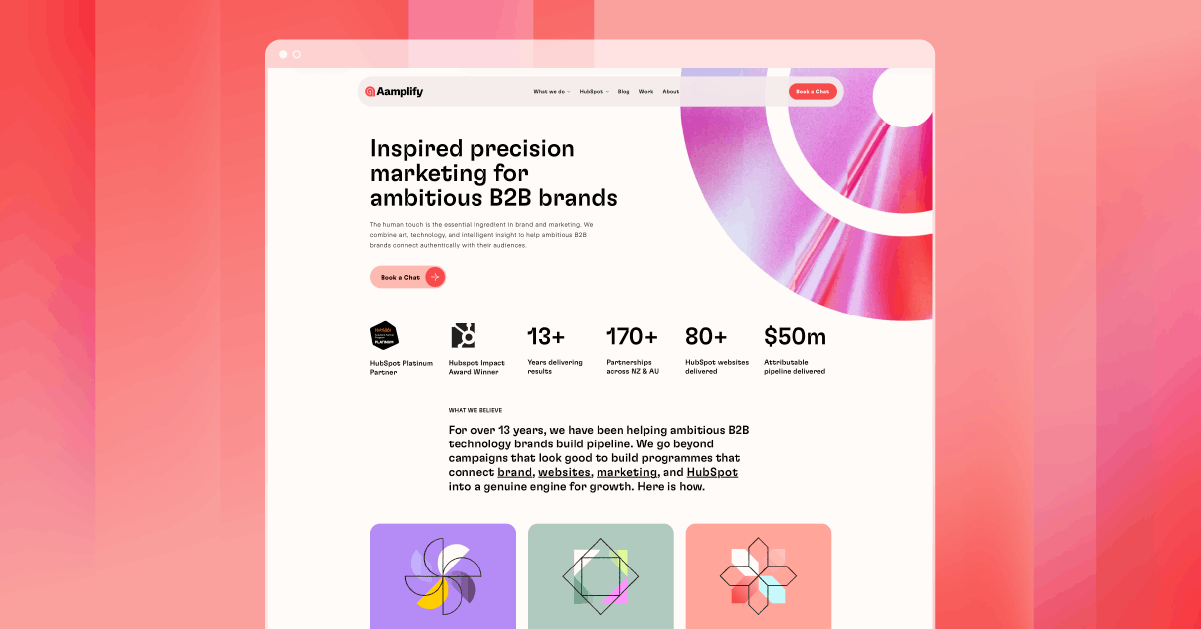
Our old website was a brochure with a URL. Service pages that could have described almost any HubSpot agency in the country, a homepage that said a lot of words without committing to who any of them were for, and a build straining under the weight of everything we wanted it to do. We know this because it's the exact problem we diagnose for clients on a fairly regular basis. Turns out recognising the symptom in someone else's business is a lot easier than spotting it in your own.
It wasn't one thing. It was a stack of things, each one making the next one worse.
The obvious one first: once the new brand and messaging existed, the old site simply didn't match it anymore. New positioning, new visual identity, new way of talking about what we do, sitting on top of a design built for a completely different version of Aamplify. That alone meant a full design overhaul, not a coat of paint.
Underneath the design problem was a bigger one. The site was built on a website framework that was six years old. It had been solid in its day. We're not being falsely modest about our past selves here, but six years is a long time in HubSpot years. Content Hub has moved on a long way since then, and we simply didn't have access to a lot of the tools and functionality now available to us. Every time we wanted to do something a bit more ambitious from a marketing perspective, we'd run into the ceiling of what the old framework could do.
That capability gap had a direct knock-on effect: speed to market. Campaigns that should have taken days to stand up took weeks, because half the build had to happen around the limitations of the platform rather than the idea itself. Some things we wanted to do, we simply didn't, because the cost of forcing them through an ageing framework wasn't worth it. If you've ever sat in a meeting explaining why a good idea isn't happening this quarter because of the CMS, you'll know exactly the flavour of frustration we're describing.
And then there was speed of an entirely more literal kind. Technology has moved on, buyer expectations have moved on, and a site running on six-year-old foundations was never going to deliver the performance we now expect to deliver for our own clients, let alone for ourselves.
A full design overhaul was the visible part. Underneath it, we rebuilt on the current Content Hub, which unlocked a fundamentally different level of tooling: modules, personalisation, workflow integration, all the things that had been sitting just out of reach on the old framework. That single change is doing more for our speed to market than almost anything else in this project. What used to take weeks to build now takes days, because we're no longer working around the platform, we're working with it.
Performance came with it. The new site is faster, cleaner, and built on infrastructure that isn't fighting us at every turn. That matters for the obvious UX reasons, and it matters for a less obvious one too, which we'll come back to.
We also gave a lot more attention to clearly explaining what we do. The old site described capabilities in general terms and left people to work out whether we were relevant to them. The new one has a dedicated page for very nearly every service we offer, each one built around a simple, logical experience: what the problem looks like, how we solve it, what it delivers. Nobody should have to work hard to figure out whether Aamplify does the thing they need done.
We're also building out a much better showcase of the outcomes we've generated for clients. We'll be honest, this part is still very much a work in progress. We believe in continuous improvement over a perfect launch, and over the coming months you'll see a lot more proof of work land on the site: full case studies, outcomes, the kind of detail that lets a prospective client see themselves in the results rather than take our word for it.
One specific piece of the rebuild is worth calling out on its own, because it's genuinely new territory: AEO, or Answer Engine Optimisation. Buyers increasingly research vendors inside ChatGPT, Perplexity, Gemini and Copilot before they ever land on a website, and the old site had nothing in place to be found, cited or accurately represented in those answers. The new site's page content and structure has been built with that squarely in mind: clear entity definitions early on each page, content structured so an AI model can parse and quote it accurately, and a technical foundation underneath that supports it. Throughout, we've held ourselves to the same standard we set for clients, specificity and evidence over generality and assertion, because that's what earns a citation rather than a vague mention. It's one part of a much bigger rebuild, not the whole story, but it's a part we think matters more with every passing month.
The new site also does something the old one never really attempted: it puts our people and our experience front and centre. That includes something specific, content published under the names of the people who did the work, rather than a faceless company voice. That matters for two audiences at once. For a human prospect doing due diligence, seeing the actual people behind the work, and the actual experience they bring, builds a kind of trust a generic services page never will. For an AI model trying to work out whether Aamplify is a credible, authoritative source worth citing, named expertise is a citation asset in its own right, a person and their track record are easier to trust than an anonymous byline. Real people, real expertise, real track record, visibly and consistently represented, is doing double duty here: convincing the person and convincing the algorithm that's increasingly standing between us and them.
We had, and still have, big ambitions for this website. Trying to deliver all of them before launch day would have meant not launching for a very long time. So we did what we'd tell any client to do: we defined an MVP, the content and functionality that would deliver the biggest impact on day one, and we launched with that.
It's not the finished picture. It's the version that gets the fundamentals right, the design, the platform, the messaging, the AEO foundations, and gives us a much easier base to build from. Because we're no longer fighting a six-year-old framework, adding new content, new pages and new functionality from here is a matter of weeks, not a project in its own right. That's arguably the biggest structural change of all: not just a better website, but a website we can keep improving without every enhancement becoming its own small ordeal.
We could tell you the whole thing was mapped out perfectly from the first workshop. It wasn't. Priorities shifted more than once as we worked out what mattered most, and the AEO thinking in particular sharpened considerably partway through the build, once it became obvious how much ground was shifting under every B2B website, including our own. That's a more honest account of how good work actually gets made than pretending we had it all figured out on day one.
What we ended up with is a site that finally reflects what we tell clients every day: brand, platform, content and performance aren't separate line items competing for budget, they're one system, and it only works properly when it's built and improved that way.
A fair bit of what follows is stuff we say to clients on a fairly regular basis. Turns out drinking your own kool-aid hits a bit different when it's your own website on the line.
A phased approach works, if your project can carry it. As mentioned, our old site was actively holding us back, so being able to launch and start realising value sooner rather than later was vital. Because we didn't try to ship everything at once, we can now get stuck into the more technical foundations of the site while we keep developing new content alongside it, rather than sitting on our hands waiting for one enormous release.
It takes a village. You cannot underestimate how much time and focus a website project requires. We co-deliver projects with clients all the time, and not getting internal teams to properly dedicate time to their side of it is consistently the number one reason projects slip. Turns out that's just as true when the client is us. Everyone here already had a full-time job before this landed on top of it, and carving out real, protected time for our own project took more discipline than we'd like to admit.
Designing for AEO and SEO together is an art form in its own right. There's a real balance to strike between writing copy that appeals to a human reader and content that reads clearly to an AI model, without either one feeling like an afterthought. The same goes for how it's presented: structured clearly enough for a bot to parse with confidence, but still something a person actually wants to read, rather than a wall of headings and bullet points doing its best impression of content. Get that balance wrong in either direction and you've built for one audience at the expense of the other.
Launch is the start of this, not the end of it. Here's where we're taking it from here.
More relevant content and offers, spearheaded by AEO. We want to fuel the site with compelling content, published at a cadence that drives organic growth rather than just ticking a box. Delivered in a measurable way, so we can see clearly what's working and keep focusing effort on that rather than guessing.
Automated customer experience and greater segmentation. The more content we produce, the more thought needs to go into how we collect and store the data behind it. Clean data is marketing gold, and it's what will ultimately power how well we're able to communicate with our audience.
Deeper personalisation. This flows straight on from segmentation. The better we get at that groundwork, the more layers we can add to the site to deliver something that feels meaningfully tailored, rather than the same experience for every visitor regardless of who they are or why they're there.
Showcasing what we do. This is what agencies live and die by, and it's an area we know we can still do more with. Expect a much greater emphasis on promoting the breadth of work we deliver, not just the handful of case studies that happen to be finished first.
Expertise and thought leadership. Expect more high-value content from the team at Aamplify, tracked in a measurable way so we know what's landing and what isn't. We'll be looking to pipe that expertise into every corner of the website, not just a blog tucked away in the footer.
AEO, AEO, and more AEO. This one isn't a project we tick off and move on from, it's ongoing. We've built the foundation and defined our brand truth set, and from here it's about consistently executing against it, page by page, month by month. AEO is a journey rather than a destination, and it takes patience: the results compound over time, they don't arrive overnight. We're in it for the long haul, and we'd rather say that plainly now than promise a shortcut that doesn't exist.
There's more to come on why brand and AEO matter well beyond agencies overdue for a refresh, and it applies just as much to your business as it did to ours.
In the meantime, take a proper look around. The new site's live, and for the first time in a while, we think it's telling our story the way it deserves to be told.

Max Allen is Director of Product at Aamplify, a digital creative director and product designer who helps businesses grow through digital, web, UI/UX and brand design that solves real business problems. His award-winning, outcome-focused work drives engagement, demand and revenue.
Join the newsletter
Get our take on the latest B2B marketing and HubSpot news, delivered to your inbox each month.
The right agency relationship starts with an honest conversation. Complete the form below and tell us where you're at. We read every word, so don't hold back.
We usually respond back within 30mins on business days.
Trusted by leading companies worldwide